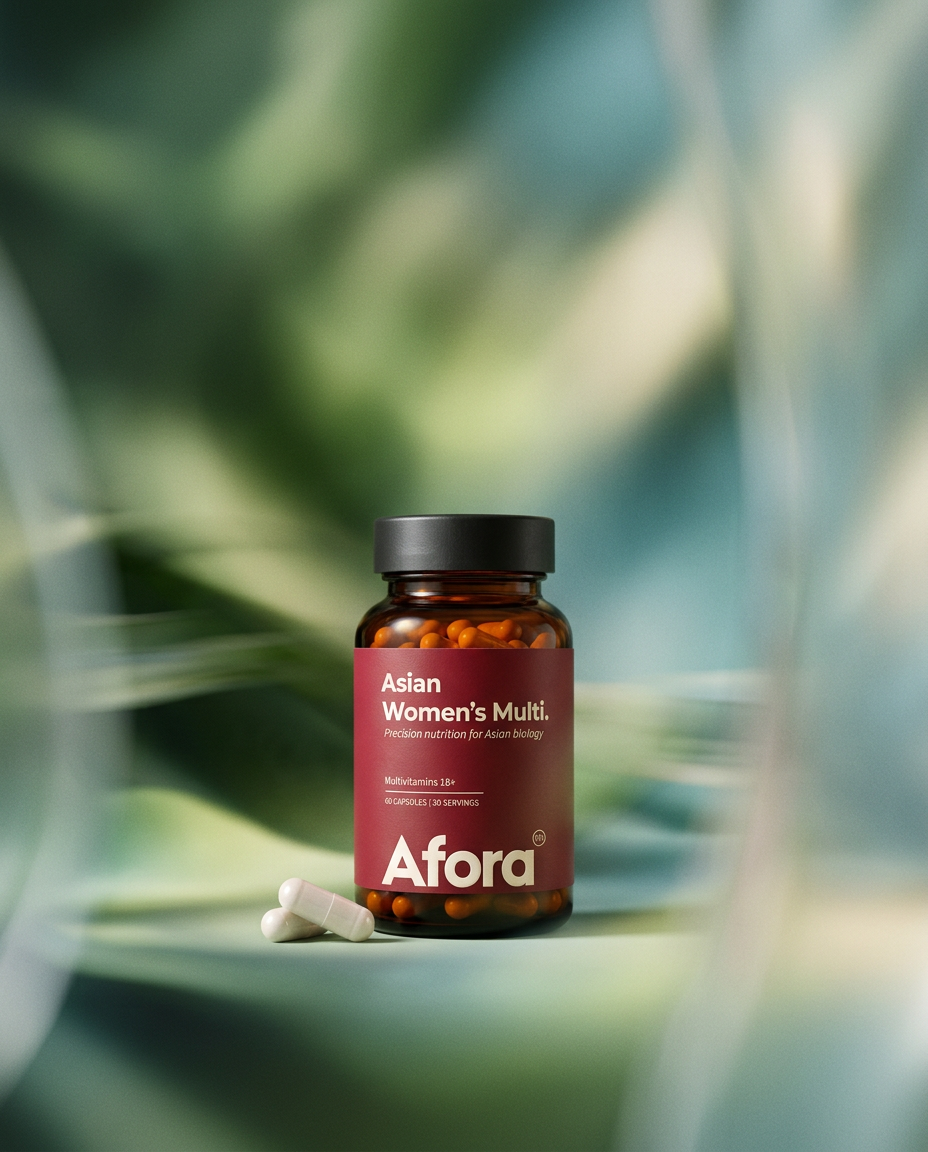
The science behind nutrition built for Asian biology.
Most multivitamins were formulated around Western research, Western diets and Western populations. Afora starts from Asian biology — the genetics, eating patterns and daily routines of Asian adults — and chooses every nutrient form to match.
We read the population research, source the most bioavailable forms we can, and print every detail on the label. In an industry that runs on hype, we let the evidence do the persuading. Here is how we think about it.
Your body can only use the nutrients it can absorb and convert. Which forms do that best depends on biology, and biology follows different patterns across populations. Three differences shape how we formulate:
01
Dairy doesn't suit everyone
Most Asian adults produce little lactase after childhood, which makes dairy a less reliable source of calcium and related nutrients than Western guidelines assume.
02
A common folate gene variant
The MTHFR C677T variant, which slows the conversion of folic acid into its active form, is common in several Asian populations.
03
Sunny climate, low vitamin D
Indoor work, air-conditioned commutes and careful sun protection mean vitamin D insufficiency is widespread across Southeast Asia despite year-round sun.
Never a single trick. One goal: nutrients your body can use.
We start with the research, then choose each nutrient form for how well it's absorbed, how gently it's tolerated and how directly the body can use it. These are the principles behind every capsule:
Chelated minerals
Minerals bound to amino acids, such as bisglycinates, are absorbed efficiently and tend to be gentler on the stomach than cheaper mineral salts.
Active B vitamins
Methylfolate and methylcobalamin arrive in the forms the body already uses, so there's no conversion step to depend on.
Nutrients that work together
Vitamin D3 paired with K2, and iron paired with vitamin C: combinations chosen because they support each other's role in the body.
Nothing hidden
No proprietary blends. Every nutrient, form and dose is printed on the label and shown on this site.
“Our mission is simple: build nutrition around Asian biology, because who a formula is made for shapes everything it can do.”
02 — The evidence
Most multis were built for someone else.
Most daily vitamins on pharmacy shelves were designed around Western nutritional research. Western diets. Western populations. But biology isn't universal: lactose tolerance, folate metabolism and vitamin D status all follow different patterns across Asia.
We design around those differences, with nutrient forms chosen for how they're absorbed.
Formulated for Asian biology. Grounded in published research.
01 / 04
Lactose intolerance is the norm, not the exception.
Across Asia, most adults produce little lactase after childhood, so dairy is a less dependable source of calcium than Western guidelines assume.
Nutrients in focus
CalciumVitamin D3Vitamin K2
02 / 04
A common gene variant changes how folate is used.
The MTHFR C677T variant slows conversion of folic acid into active folate, and it is common in several Asian populations.
Nutrients in focus
MethylfolateVitamin B12Vitamin B6
03 / 04
Year-round sun, yet vitamin D often runs low.
Indoor lifestyles and sun protection mean vitamin D insufficiency is widespread across Southeast Asia, including in the tropics.
Nutrients in focus
Vitamin D3Vitamin K2Magnesium
04 / 04
Iron needs shift with life stage and sex.
Iron deficiency remains one of the most common nutrient gaps among women of reproductive age in Asia, and the form affects comfort as much as absorption.
“Nutrition research has long been built on Western populations. We start from studies of Asian adults, and only then decide what belongs in the capsule.”
Principle 01 · Population-first research
“A dose on a label means little if the body can't absorb it. We choose chelated minerals and active vitamins for how directly your body can use them.”
Principle 02 · Bioavailability over big numbers
“If we can't explain an ingredient, it doesn't go in. Every nutrient, form and amount is on the label, with no proprietary blends and no fine print.”
Principle 03 · Full label transparency
Per day
2 capsules
Per bottle
30 servings
Made for
Adults 18+
04 — The ingredients
The forms we choose, and why they matter.
The same nutrient comes in many forms, and they are not equal. We compare forms for absorption, tolerance and how directly the body can use them, then choose accordingly. Tap any ingredient for the detail.
Folic acidSwapped for methylfolateIt relies on the MTHFR enzyme to activate, and a variant common in Asian populations slows that enzyme down.
Vitamin D2Swapped for vitamin D3Ergocalciferol is generally less effective than D3 at raising blood vitamin D levels.
Ferrous sulfateSwapped for iron bisglycinateA cheap iron salt that is more likely to cause stomach discomfort than chelated iron.
Magnesium oxideSwapped for magnesium glycinatePoorly absorbed and more likely to upset digestion.
Iron for menLeft out of the men's formulaMost adult men meet their iron needs through food, so the men's formula leaves it out.
Proprietary blendsNever usedEvery nutrient, form and dose is printed on the label, with nothing hidden in a blend.
Vitamin D3
Cholecalciferol
Both formulas · 2,000 IU (50 mcg)
The form of vitamin D your skin makes from sunlight. It supports normal calcium absorption, bone health and immune function.
Why it matters in Asia
Most Western multis give 400–600 IU, a dose set for regular sun exposure in temperate climates. In urban Asia, office work, deliberate sun avoidance, higher melanin and air pollution all cut vitamin D production. Studies across Singapore, China, South Korea and Japan show 40–70% of adults below 50 nmol/L; in one Singapore study, 42% of healthy adults were deficient despite year-round sun.
Why this form
Afora provides 2,000 IU as cholecalciferol (D3), not ergocalciferol (D2). D3 raises blood 25(OH)D levels around 87% more effectively than D2 and stays in circulation longer.
Supports energy-yielding metabolism, red blood cell formation and normal nervous system function.
Why this form
Methylcobalamin is an active coenzyme form of B12, and it works hand in hand with methylfolate.
Folate (B9)
5-MTHF (L-methylfolate)
Both formulas · 400 mcg DFE
Folate supports normal blood formation, cell division and the reduction of tiredness and fatigue.
Why this form
Methylfolate is already active, so it doesn't rely on the MTHFR enzyme to convert it. That matters for carriers of the variant common in Asian populations.
Magnesium
Magnesium glycinate
Both formulas · 75 mg elemental
Involved in hundreds of enzyme reactions, supporting muscle function, energy metabolism and bone health.
Why this form
Bound to glycine, it is well absorbed and less likely to upset digestion than magnesium oxide.
Zinc
Zinc bisglycinate
Men's · 15 mg elementalWomen's · 10 mg elemental
Supports normal immune function, skin, hair and nails, and protection of cells from oxidative stress.
Why this form
Chelated zinc is absorbed efficiently and is less affected by the phytates in grain- and legume-rich diets.
Iodine
Potassium iodide
Both formulas · 150 mcg
Supports normal thyroid function and the production of thyroid hormones, which help regulate metabolism.
Why this form
Potassium iodide is a stable, well-absorbed source of iodine and the standard form for meeting daily needs.
Vitamin B2 (Riboflavin)
Riboflavin-5-phosphate (R5P)
Men's · 1.3 mgWomen's · 1.1 mg
Supports energy-yielding metabolism, normal vision and the reduction of tiredness and fatigue.
Why this form
R5P is the active, phosphorylated form of riboflavin. It's also a cofactor for the MTHFR enzyme, so it complements methylfolate.
Vitamin B6
Pyridoxal-5-phosphate (P5P)
Men's · 1.7 mgWomen's · 1.5 mg
Supports energy metabolism, hormonal activity and normal psychological function.
Why this form
P5P is the active coenzyme form of B6, ready to use without conversion in the liver.
Lycopene
Tomato extract, standardised
Men's formula only · 6 mg lycopene
The red carotenoid pigment in tomatoes, studied for its antioxidant role and its relevance to men's health.
Why this form
A standardised tomato extract delivers the same amount of lycopene in every capsule.
Vitamin A
Beta-carotene + retinyl palmitate
Both formulas · 700 mcg RAE
Supports normal vision, skin and immune function.
Why this form
Retinyl palmitate supplies ready-to-use vitamin A, while beta-carotene is converted only as the body needs it. The men's formula splits the two 50/50; the women's leans 70/30 toward beta-carotene, keeping the preformed dose lower.
Vitamin C
Ascorbic acid
Men's · 150 mgWomen's · 200 mg
Supports normal immune function and collagen formation, and increases the absorption of iron from food.
Why this form
Ascorbic acid is the most studied form of vitamin C, and it is the same molecule found in fruit and vegetables.
Vitamin E
Mixed tocopherols
Both formulas · 20 mg alpha-TE
A fat-soluble antioxidant that helps protect cells from oxidative stress.
Why this form
Mixed tocopherols supply the family of vitamin E forms found in food, rather than alpha-tocopherol alone.
Vitamin K2
Menaquinone-7 (MK-7)
Both formulas · 90 mcg
Works alongside vitamin D3 and calcium, supporting the proteins involved in normal bone maintenance.
Why this form
MK-7 stays in circulation longer than other forms of K2, so a small daily amount goes further.
Vitamin K1
Phylloquinone
Both formulas · 50 mcg
The form of vitamin K found in leafy greens, needed for normal blood clotting.
Why this form
Paired with K2: K1 is the form the liver uses for clotting, while MK-7 reaches bone and other tissues.
Vitamin B1 (Thiamine)
Thiamine HCl
Men's · 1.2 mgWomen's · 1.1 mg
Supports energy-yielding metabolism and the normal function of the nervous system and heart.
Why this form
A stable, well-absorbed form. Thiamine matters where polished white rice is a staple, since milling removes much of the grain's B1.
Vitamin B3 (Niacin)
Niacinamide
Men's · 16 mg NEWomen's · 14 mg NE
Supports energy-yielding metabolism, normal skin and the reduction of tiredness and fatigue.
Why this form
Niacinamide delivers vitamin B3 without the skin flushing that nicotinic acid can cause.
Vitamin B5
Calcium pantothenate
Both formulas · 5 mg
Supports energy-yielding metabolism and normal mental performance.
Why this form
Calcium pantothenate is the stable, well-studied form of pantothenic acid.
Biotin (B7)
D-biotin
Both formulas · 30 mcg
Supports energy-yielding metabolism and the maintenance of normal hair and skin.
Why this form
D-biotin is the naturally occurring, biologically active form of biotin.
Copper
Copper bisglycinate
Men's · 1.5 mg elementalWomen's · 1 mg elemental
Supports normal iron transport, connective tissue and immune function.
Why this form
Included to balance zinc, since regular zinc intake can lower copper status. Chelated for gentle absorption.
Selenium
L-selenomethionine
Both formulas · 55 mcg
Supports normal thyroid and immune function, and protects cells from oxidative stress.
Why this form
Selenomethionine is the form found naturally in foods, and it is absorbed more efficiently than inorganic selenite.
Manganese
Manganese bisglycinate
Both formulas · 1 mg elemental
Supports normal energy metabolism, bone maintenance and the formation of connective tissue.
Why this form
Chelated to glycine like our other minerals, for efficient and gentle absorption.
Chromium
Chromium picolinate
Both formulas · 100 mcg
Contributes to the maintenance of normal blood glucose levels and macronutrient metabolism.
Why this form
Picolinate is one of the best-absorbed and most widely studied forms of chromium.
Molybdenum
Sodium molybdate
Both formulas · 45 mcg
A trace mineral that contributes to normal sulphur amino acid metabolism.
Why this form
A soluble, well-absorbed source, used at a modest daily dose.
Choline
Choline bitartrate
Both formulas · 50 mg choline
Contributes to normal liver function and lipid metabolism.
Why this form
Choline bitartrate is a stable, well-absorbed source of a nutrient many diets fall short on.
Lutein
Marigold flower extract
Both formulas · 5 mg lutein
A carotenoid that concentrates in the macula of the eye, studied for its role in filtering blue light.
Why this form
Marigold flowers are the richest natural source of lutein, and the extract pairs it with zeaxanthin as they occur in the eye.
Zeaxanthin
Marigold flower extract
Both formulas · 1 mg zeaxanthin
Works alongside lutein in the macula, the part of the eye responsible for sharp central vision.
Why this form
Supplied in a 5:1 ratio with lutein, from the same marigold extract.
Two capsules with breakfast, at your desk or on the go. Built to fit the way you already live.
*Supplements are not intended to diagnose, treat, cure or prevent any disease, and should not replace a varied, balanced diet. The research referenced on this page describes populations and does not predict any one person's needs. Speak with your doctor before starting a supplement, especially if you are pregnant, breastfeeding, taking medication or managing a health condition.